Why does my house smell like sewage even though nothing is backed up?
A sewer smell with no visible backup usually means sewer gas is getting into the house through a path other than a clog. The most common cause is a dry trap. Every drain has a U-shaped trap that holds water as a seal, and in a rarely used drain, like a basement floor drain or a guest bathroom, that water evaporates. Pouring a bucket of water down the drain refills the seal, and it often fixes the smell in minutes, so that is a safe homeowner check. A loose or failed wax ring under a toilet can leak gas at the base, and a rocking toilet is a clue. A cracked vent pipe in the attic or wall can release gas inside the house. Outside, a damaged sewer line or an open cleanout can send the smell into the yard and then indoors. If the smell is strong, comes with slow drains, or you feel dizzy or sick, leave the area and call right away. If it lingers after you refill the traps, the vent stack or the sewer line itself may need a camera check. Call Expert Plumbers Co at (380) 262-9173 to get connected with an independent local plumber in Mayville, ND.
One thing worth knowing is that the smell often follows a pattern, and the pattern points to the source. If it is strongest right after you run a shower or flush a toilet, the gas is probably escaping from a leaking drain joint or a cracked vent inside a wall. If it comes and goes with the weather, a low-pressure day or strong wind can pull gas back down a vent. In older homes, deteriorated cast iron or lead-and-oakum joints are common leak points. Newer homes with plastic pipe more often have a missed glue joint or a dried trap. When you talk to the plumber, say which room the smell is in, what time of day it shows up, and whether it changes after water use. That detail can save an hour of searching. Expect the fix to be small if a trap or wax ring is the cause, and larger if a wall has to be opened to reach a joint.
What should I tell the plumber on the phone so the right equipment turns up?
Describe what the water is doing and how often it has happened. Those two details decide which tool is needed.
When you call Expert Plumbers Co, a referral service, we ask the same questions. The answers shape the referral to an independent local plumber.
One fixture or every drain? One slow sink is a branch line, and a cable machine often handles it. Every drain backing up points to the main line or a blocked vent stack, which is a bigger job.
Is water rising, or just slow? Rising water means the line is nearly shut. Say so first.
Does anything gurgle when another fixture runs? Gurgling suggests a blocked vent stack or a partial blockage in the main line.
How long has it been happening, and has it been cleared before? A repeat blockage points to a fixed fault, such as root intrusion at a clay joint or a bellied line holding water. Another cable run only buys time. That is a camera inspection case.
Is there a cleanout, and roughly where? Access changes how the equipment gets in.
What is the pipe made of, and how old is the house? In older housing stock, clay and cast iron are common. Clay joints let roots in. Cast iron can scale up inside.
Septic tank or city sewer? A septic system changes where the problem can sit and which tool is safe to use.
Basement or slab? A basement often gives a lower access point. A slab can mean opening the floor or working from outside.
What the work involves depends on access, the pipe materials, how much has to be opened up and any permit or code requirement. Call (380) 262-9173 and we will refer you to an independent local plumber in Mayville, ND.
Have a few practical things ready before the plumber arrives. Clear a path to the cleanout, the basement or the crawlspace, and move stored items out of the way. Know where the main water shutoff is and be ready to show it.
If you can, take a short phone video of the symptom, such as water rising in a tub when the washer drains. Intermittent problems often vanish by the time anyone arrives, and a video shows what the water was doing.
Mention anything poured down the drain recently, including chemical cleaners. Those affect which tools can be used safely, and the plumber needs to know before reaching into the line.
Say if pets or small children are in the home, and keep your phone nearby, because the plumber may call to confirm the address and access details. Answers ready on the first call shorten the visit and help the right equipment arrive the first time.
Our walk-in shower has a long linear drain and it keeps backing up. Why?
Your walk-in shower has that long, slim linear drain along one wall or the back edge, and it keeps backing up. The water rises around your feet, drains slowly, then does it again a week later. There are a few reasons a linear drain behaves this way.
The channel is long and shallow, so it collects hair and soap scum along its whole length. Many linear drains also have a small outlet at one end or in the middle, often undersized compared to the flow from a large shower head. If the pan is built with a low slope toward the drain, water crawls instead of running, which leaves scum behind and lets hair settle. Under the cover, the trap or the first section of pipe can also fill with hair, so the channel looks clean and still backs up.
If only the shower backs up and the sink and toilet in the same bathroom are fine, the problem is the channel, its outlet, the trap or the shower branch. If other fixtures are slow or gurgling, or water shows in a floor drain, the line further down is involved.
Safe homeowner check: lift out the grate or cover and clean the channel with gloves. Look at how water moves across the floor, because standing water on the pan suggests a slope problem rather than a clog alone. Skip chemical openers.
Stop running water and call now if sewage or gray water comes up elsewhere, if you see moisture on the ceiling or walls below the shower, if the floor around the shower feels soft, or if a sewer smell comes with the backups. A leaking pan is a different problem from a clog and can damage the structure.
A cable machine is usually enough for hair and soap in the trap or short branch, though the plumber must be able to get past the channel outlet. If the problem keeps coming back, a camera inspection can show a belly, offset or roots beyond the shower. Hydro jetting may be proposed when the pipe wall is coated with grease or scale.
Expert Plumbers Co is a referral service. We connect you with an independent local plumber in Mayville, ND. Call (380) 262-9173.
Ask the plumber whether the cause is the drain body, the slope of the pan or the pipe beyond it. If the slope or outlet is the problem, ask what it takes to correct it. The scope depends on access to the drain, the parts or materials needed, how much tile or floor has to be opened up, and any permit or code requirement.
Our drains only back up in the morning when everyone is showering. Why only then?
Everything is fine all day, then at seven in the morning the shower pan fills up and the toilet gurgles. This is the classic sign of a partial blockage in the main drain.
A line with a partial clog still carries a normal trickle. One person washing their hands never notices. But when two showers, a washer and a toilet all run at once, more water arrives than the narrowed pipe can pass, and the extra has nowhere to go but up the lowest opening in the house. Once the rush ends, the pipe catches up and the problem seems to vanish.
The usual causes are a root mat growing through a clay joint, a bellied section of pipe that holds a pool of water and debris, grease build-up on the pipe wall, or scale narrowing an old cast iron line.
The key question is how many fixtures are affected. One slow fixture, such as a single shower, usually points to a clog in that fixture's own trap or branch line. When the tub, floor drain and toilets all struggle at the same time, the problem sits in the shared main, and it will keep returning at peak load until it is cleared properly.
Safe homeowner check: stagger your mornings for a day. Run one shower, then wait, and watch whether the lowest drain in the house, often a basement floor drain or a ground-floor tub, stays calm. Note which fixtures react first and write down the times. That list is useful to the plumber.
Stop running water and call now if sewage is coming up in a tub or floor drain, if a drain is overflowing onto the floor, or if you smell sewage inside the house. Do not keep using showers and the washer while the line is backed up.
A cable machine is often enough for a soft blockage such as a small grease or paper clog. If roots, a belly or heavy build-up is suspected, the job usually needs a camera inspection to see the pipe, and hydro jetting to clean the pipe wall rather than just poke a hole through the clog.
Expert Plumbers Co is a referral service. We connect you with an independent local plumber in Mayville, ND. Call (380) 262-9173.
When you speak to the plumber, mention that the backups only happen at peak use. Ask whether a camera inspection is included before any jetting, and ask what they found on the pipe, not just that it was cleared. Scope and cost depend on access to the line, whether a cleanout exists, how much has to be opened up if a section is damaged, and any permit or code requirement for repairs.
The plumber wants to pull the toilet to reach the line. Why would they do that?
You called about a slow drain, and now the plumber says the toilet has to come off the floor. It is actually a common and sensible move, and it is often the cleanest way in.
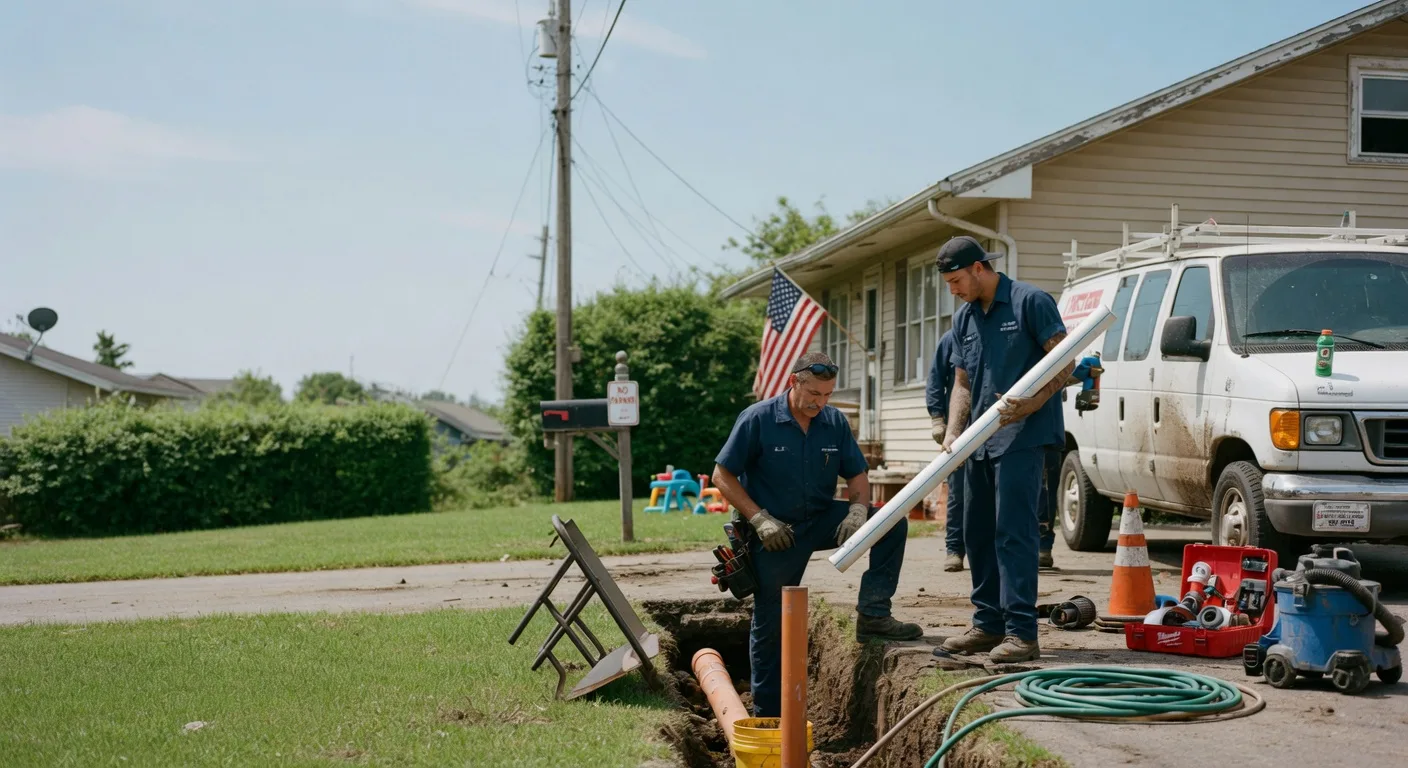
A cable or jetting hose needs a way into the line. The best entry is a cleanout, a capped pipe fitting on the main drain. Many houses do not have one, or it is buried, painted over or blocked by a wall. Without a cleanout, the toilet is usually the best access point in the house. Pulling it exposes the closet flange and gives the plumber a short, straight shot into the closet bend and then into the main. Going in through a sink or tub means tight turns and a trap, and the tool may never reach the real problem.
It matters most when the blockage is past the branch lines. Roots at a clay joint, a belly holding water, or grease further down the main sit well beyond the bathroom. A straight path lets the cable or jet hose get there with enough control to clear it and, if a camera is used, to see what the pipe looks like.
Think about whether it is one fixture or the whole house. If only the bathroom sink is slow, the plumber should work at that sink. If the toilets gurgle, the tub backs up and a floor drain bubbles, the problem is in the main, and pulling the toilet is a reasonable way to reach it.
Safe homeowner check: look in the basement, crawl space or outside wall for a capped cleanout fitting on the main drain, and tell the plumber where it is. Do not pull the toilet yourself unless you are comfortable with it. The bolts can seize, and the bowl is heavy.
Stop running water and call now if sewage is coming up in a tub or floor drain, if the toilet is overflowing, or if you smell sewer gas.
A cable machine is enough for a simple clog near the closet bend. Roots, a belly or heavy build-up usually call for a camera inspection first, and hydro jetting to clean the pipe wall.
Expert Plumbers Co is a referral service. We connect you with an independent local plumber in Mayville, ND. Call (380) 262-9173.
Ask the plumber if a cleanout will be added so the next visit does not need the toilet pulled. Also ask about the new wax ring and any damaged bolts or flange, since the toilet must be reset and sealed afterward. Scope depends on access, parts, the condition of the floor around the flange, and any code requirement for adding a cleanout.